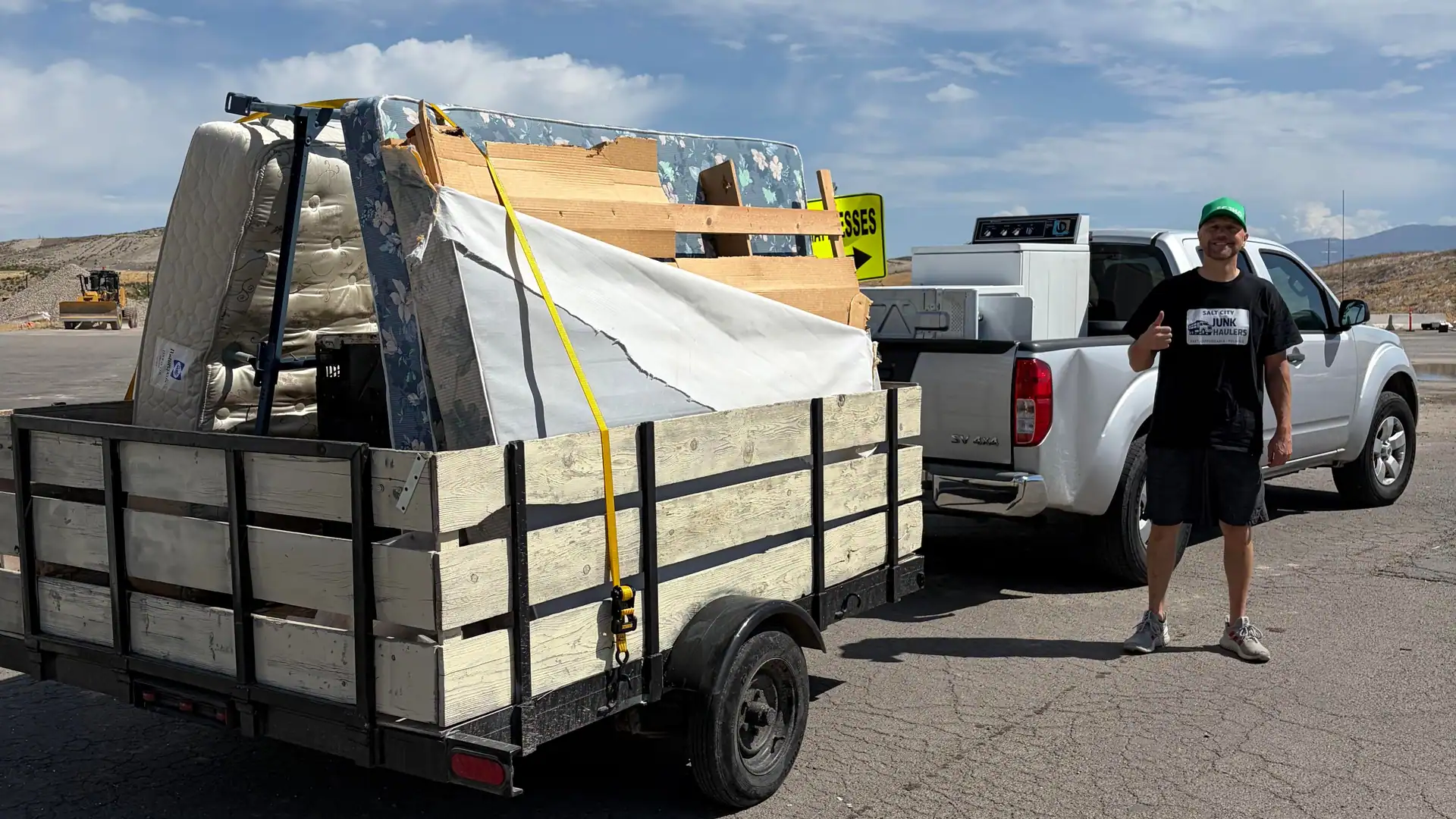
TV disposal and electronics pickup in Salt Lake City
TV and electronics pickup in Salt Lake City: old TVs, monitors, computers, and dead electronics carried out from wherever they sit.
 Jobs from $100
 Licensed & insured
 Answers his own phone
 One-hour arrival window
Get a price from a photo
Text a photo Call (801) 557-1063Rated 5 out of 55.0 on Google · 30 reviews
The old TV is the thing that never leaves. It's too heavy for one person, the trash truck won't take it, and it's been sitting in the basement since the new one went up on the wall. Jeremy picks up TVs, monitors, computers, printers, stereos, and the rest of the dead-electronics pile from homes and businesses across the Salt Lake Valley.
It comes off the wall mount, out of the basement, or out of the back of the closet, and it goes on the truck with whatever else is leaving. One TV on its own is a normal job. A TV added to a garage cleanout gets priced with the rest of the pile.
Text a photo to (801) 557-1063 and you'll get one number back for the whole thing. No drop-off line and no lifting.
What goes on the truck
- Flat-screen, tube, and projection TVs
- Monitors, desktops, laptops, and printers
- Stereos, speakers, and receivers
- Game consoles, DVD players, and cable boxes
- Microwaves and small appliances
- Entertainment centers and TV stands
Text a photo of your pile to (801) 557-1063.
The full list of what goes on the truck, and what doesn't.
What counts as electronics
Pretty much anything with a plug or a screen. Flat-screen TVs and the big old tube sets that weigh as much as a fridge. Projection TVs still in their cabinets. Computer monitors, desktop towers, laptops, printers, and the tangle of cables behind them. Stereos, speakers, receivers, and DVD players. Game consoles, cable boxes, and routers. Microwaves and small kitchen appliances. Treadmills and exercise bikes with a console count too.
If it still works and somebody could use it, say so in the text. Some people call a pile of old electronics e-waste and some call it electronics disposal, and Jeremy hauls the same load either way.
What happens to the TV
TVs and electronics ride with the rest of the load and get priced by the room they take up on the truck. If a TV or computer still works, say so in the text. The rest of the pile is sorted the same way as every job.
If a computer is in the pile, wipe the hard drive before Jeremy arrives. Nothing needs to be boxed or bagged first, and the cords can ride tangled.
Carried out, not set out
The difference between a hauler and a drop-off is who does the carrying. Jeremy takes the TV off the wall if it's still up, walks it down the stairs, and loads it. Same for the desktop computer under the desk and the printer that hasn't printed since the last move. It doesn't have to be at the curb, though a TV already set in the garage or by the driveway is the quickest version and keeps the price down. Either way you don't have to be home if the price is set and he can get in.
Big tube TVs and projection sets are the awkward ones, wide and top-heavy. Send a photo that shows the size and where it's sitting so the number accounts for the stairs.
Add it to the pile
Most TVs leave with something else: the entertainment center it sat in, the couch that faced it, the old desk the computer lived on. One text with everything in the picture gets you one price for all of it. If a fridge, freezer, mattress, or box spring is in the same load, those carry a small upcharge, and it's included in the number before anything is loaded.
The stand from before the wall mount, the soundbar that quit, the VCR and the shoebox of chargers go in the same photo as the TV. They ride on the trailer with it and into the same price. A console TV counts as a TV, cabinet and all, and the cabinet is the part that has to clear the doorway, so the photo should show how wide it is.
Businesses and offices are the same deal. A closet of old monitors, a stack of dead printers, the server rack from three moves ago: text a photo, get a number, and it's gone on a day that stays out of your customers' way.
How Jeremy loads it
Jeremy walks in and looks at the path out. That path decides how the TV comes out. A flat-screen fits through most doors on its edge, but it flexes. A tube set carries its weight up front, in the glass. The shortest line from where it sits to the trailer is the one he'll use. Slide the coffee table over and prop the storm door before he gets there.
The TV goes on the trailer and the rest of the pile fills in around it. A single flat-screen is a short stop. A projection set from the basement takes longer.
If the whole basement is going, see garage and basement cleanouts.
How the home changes the job
A TV on the main floor with the truck in the driveway is the easy version. Out the front door and onto the trailer. Add a basement and it's a stairwell with a turn at the bottom. That's where the old tube set usually sits.
In a townhome the TV comes down an interior staircase and out through a shared hallway. The carry is long and the turns are tight. In an apartment the TV goes to the elevator. If the building has one, a big screen rides it. The manager may want to know when the truck is coming. A propped door or a loading zone makes it faster.
A narrow side gate means the trailer stays out front and the TV gets walked around. A long driveway means the opposite: Jeremy backs the trailer up close to the door so the carry is short. All of it changes how long he's there.
What to put in the text
The photo does most of the work. Show the whole TV and whatever it's sitting on or hanging from, and add a second shot of the stairwell or the hallway if there's a tight turn on the way out.
Then the details: which floor it's on, whether the building has an elevator or it's a walk-up, whether the set is still on the mount, and the gate code or buzzer if he'll need one. If you won't be home, say how he gets in.
How the price works
Text a photo of what needs to go to (801) 557-1063. Jeremy looks at how much room it takes on the truck and texts back one number for the whole job. No hourly rate, and the number doesn't change once it's loaded. Jobs start at $100. The only add-ons: mattress or box spring +$40, fridge or freezer +$25, stairs +$25. He tells you before he starts. More on what junk removal costs in Salt Lake City.
Where Jeremy does this
All of the Salt Lake Valley. See every town Jeremy covers for TV and electronics removal.


One text and it's handled.
Jeremy reads his own messages and gets right back to you. Text a photo, or send the same details through the form.

Text a photo
Snap the pile, the couch, the garage, whatever needs to go. Send it to (801) 557-1063.

Get a price back
A real number for the whole job, not an estimate that changes once it's loaded.

Jeremy shows up
He does the carrying. It doesn't have to be at the curb, but if the pile can wait there or in the driveway, it's quicker and cheaper. The truck leaves full and the space is yours.
Real reviews, copied from Google.
Three of the 30, with a link to the rest.
“Best service I highly recommend this salt city junk hauler this guy was so fast and easy and beat service and i definitely will be using him again for service”
“Great service, done quickly and great communication. Highly recommend!”
“I had a lot of garbage I needed to get rid of quickly and Jeremy was able to fit me in the schedule the next day. He was quick and efficient and also swept my garage after hauling away all the junk. I am satisfied and would use his service again. Price was also very reasonable”
Questions about TV and electronics removal.
Do you take old TVs and e-waste?
Do I have to carry it out to the curb?
Can I add a TV to a bigger pickup?
Do you take the big old tube TVs and projection sets?
Is TV pickup free?

“You text me a picture. I send you a price. Then I show up and load it. That's the whole process.”
Other things Jeremy hauls.

Appliance removal
Refrigerators, washers, dryers, and water heaters hauled out and recycled.

Junk hauling & pickup
One item or a whole houseful. Text a photo, get a price, pick a day.

Commercial junk removal
Office furniture, retail fixtures, and storefront cleanouts hauled around your hours.

Furniture removal
Couches, sectionals, dressers, and bed sets. Carried out, not dragged.